
The annual State of Play report is one that I look forward to reading each year. It is a comprehensive look at sport participation trends in America.
This year’s report is no different and I’ve pulled out some of the top insights and added my notes for how we can use this information to our advantage.
1. Girls are playing more and boys are playing less. Down from over 50% in 2013 to only 41% of boys played on a team or took lessons after school or on weekend. Girls are playing at higher levels than any other year, dating back to 2012, though they still lag behind boys participation rates (34% for 6-12yr old and 38% for 13-17yr olds).
2. Children are specalising in one sport at much higher rates since the pandemic. Over a decade ago kids (6-17yrs) would average over 2 sports played. Now the average is down to 1.63. Specalising younger has many adverse effects on the long-term health of the player (burnout and overuse injuries) and an early specalisation is less likely to lead to a lifelong desire to play sport.
3. You can view a state-by-state breakdown of participation levels below. Click the image to view the data in detail.
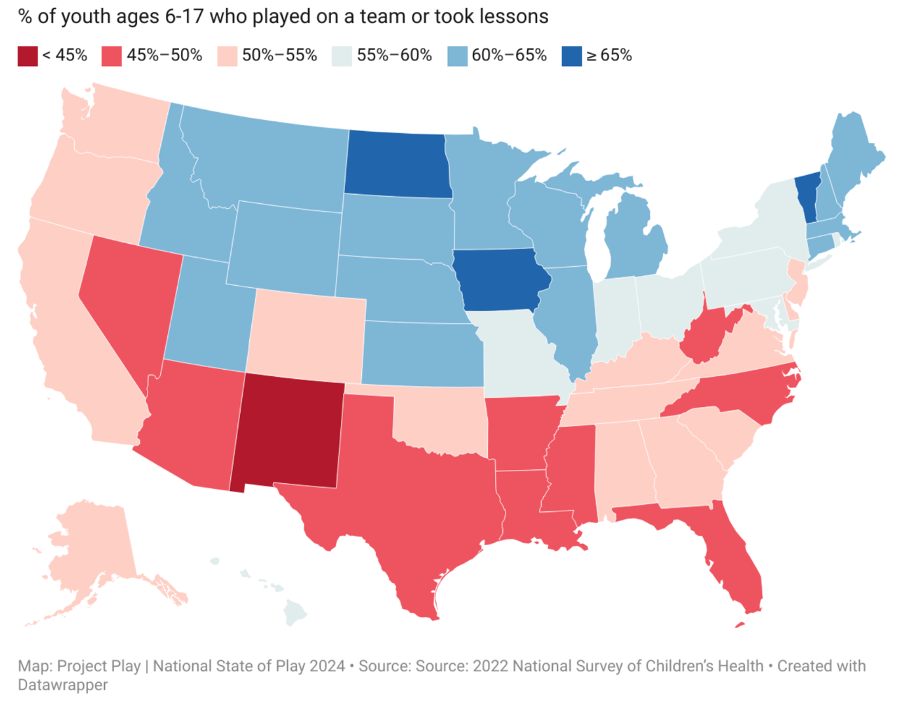
Interesting to note that the highest participating states are all largely white, relatively affluent and mainly rural and hence less densely populated. Many high schools in these states only have a few hundred students leading to less children being not making the team. We know that when people get cut from a team or they don’t make it they often drop out of the sport, often leading them to drop out of all sport.
This is where we need to differentiate between selections and grading. There is no problem with grading players into different teams A, B, C… for example. But anytime we cut people and we don’t give them a place to play we are not just turning them away from our sport but likely to lose them from playing any sport at all.
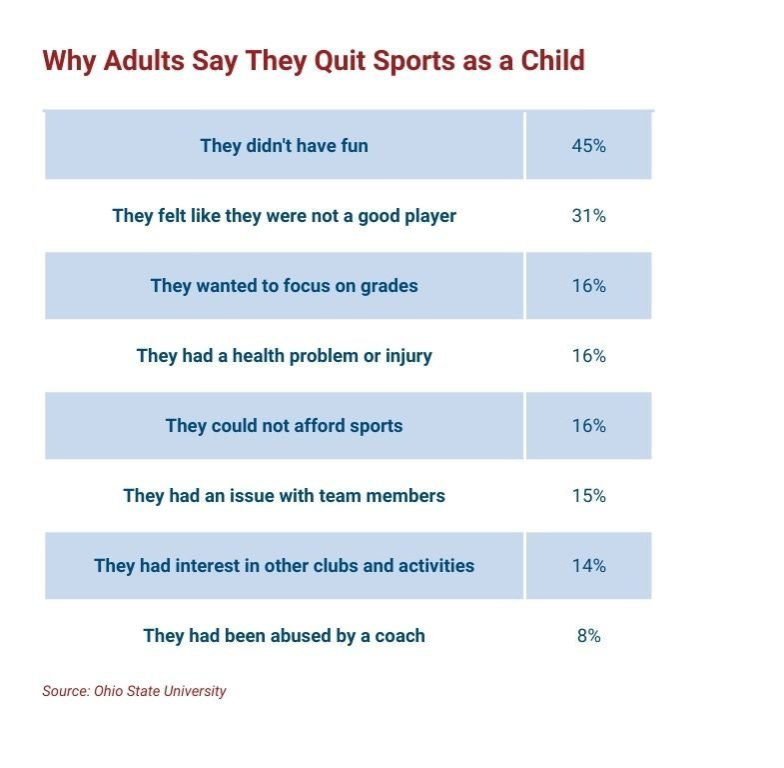
The report references one study by Ohio state university that reveals that adults who played throughout their youth have lower symptoms of anxiety and depression than those who dropped out or never played. Those who dropped out had poorer mental health than those who never played indicating just how negative dropping out can be over the long term.
This is why sports need to be so focused on ensuring no kids dropout and creating environments that best serve the players needs and motivations. There is only upside if we can make this effort.
That being said not all reasons for dropping out had the same negative impact on mental health. Dropping out to focus on grades didn’t have any mental health impacts whereas not having fun, not getting along with team members and being abused by a coach – were all associated with adult depressive and anxiety symptoms.
4. The increasing costs of sport and earlier pathways into travel teams is pushing kids out the door faster than ever before.
“Soccer is the sport that kids most often play first,” Tom Farrey, executive director of the Aspen Institute Sports & Society Program said. “But immediately, soccer starts losing them, as travel teams form and community leagues begin to wither, denying a sustained experience from late bloomers and kids whose families can’t afford the youth sports arms race. We’ve got to find a way to bring back in-town leagues.”
All this speaks to a sport system that caters for a specific individual and for everyone else the only pathway is out the door.
And it’s so simple to fix, create sport environments that are inclusive and cater toward all individuals. This includes entry points at each age, stage of development and skill level and while more skill leads to higher motivation and enjoyment, that isn’t the same as more elite competitions means more enjoyment.
5. Caitlin Clarke, Olympics and Paralympics have all inspired youth to play but the question is for how long? Typically events like Olympics inspire new participants to join but after a short period rates return to normal. If sports are unable to accommodate these new participants, or find ways to be cheap, accessible and inclusive then they will just drop back out again.
Again, it comes to how can we provide an informal, yet competitive format of the sport. Every sport is going to have a different balance of recreational and elite pathway participants. If your sport only caters for the elite pathway players, then everyone else is going to look elsewhere for their sporting experience.
The link to the full report can be found here which has a lot of further detail, a lot of which is specific to the USA. I wouldn’t be surprised if the stats I’ve shared in this article reflect what is happening in Australia also.
If you’ve enjoyed this article then you’ll love my book, For the Love of Sport which delves deep into the practical application of motivation and creating sporting environments that retain players for life.
 Lifelong Sport
Leave a comment